What’s new…

This is a little teaser of what’s to come…

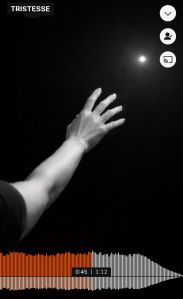
In early February a new spoken word piece will hit your ears. And let me tell you, out of everything that ever had my voice, this is the best. Working on this was very rewarding and enlightening, that much I can say.

And maybe, if things go as planned there will be more poetry for your ears in the coming weeks.

Exciting times ahead.

Have a great Wednesday

Soen – Reliance (album review)

I put Reliance on without expecting it to do anything surprising. It was released on January 16th, 2026, and I had been waiting for it in that quiet, patient way that only happens when you already trust a band. I was fortunate enough to preorder one of the 200 limited signed copies, which already gave the first listen a sense of ritual, like opening something that had chosen its place before I had even heard it. I listened for the first time on a quiet Saturday morning, the house still, the kind of stillness that feels borrowed. I played it twice back to back, not out of analysis but out of that rare, wordless awe that comes after hearing something great before your mind rushes in to explain it.


That is not a criticism, by the way. With Soen, the surprise is rarely in the shape of the music, but in how deeply it settles once you stop bracing for impact. They have always written heavy music that does not behave like heavy music. It breathes, it holds back, it waits. Their version of progressive metal is built on rhythm, repetition, and restraint rather than constant technical display. You hear echoes of Tool in the patience, Katatonia in the melancholy, and something almost post-rock in the way atmosphere carries meaning, but it never feels like imitation. It feels like a language they have refined over years of knowing exactly who they are.


The current line-up makes sense in a very physical way. Joel Ekelöf’s voice is calm and steady, but there is always something cracking underneath, like emotion being held in place by discipline. Martín López is the quiet architect of the whole thing. His drumming never shows off, but constantly shifts the ground, keeping the songs alive rather than looped. Cody Lee Ford’s guitar work is expressive without being indulgent, shaping mood more than proving skill. Lars Åhlund fills the spaces most bands forget exist, with keys and textures that change the colour of a song without demanding attention, and Stefan Stenberg’s bass gives everything weight, not just low end, but intention.


What I hear on Reliance is a band that consciously chose contrast as a compositional tool. They have spoken about writing more freely than before, experimenting with tuning, texture, and vocal approach, then cutting back hard during arrangement so the songs stayed clear and direct. You can hear that discipline everywhere. Nothing feels crowded. Nothing feels like it is there because it should be. Heavy parts are allowed to be heavy, and quiet parts are trusted to carry the song without being padded.


“Mercenary” moves forward with purpose, a tight, grounded drive that never rushes. The riff feels physical, but the song breathes around it, softened by subtle shifts that keep it from becoming rigid. Lyrically it carries the weight of inherited violence, the idea that conviction can be passed down like a burden rather than a gift. The chorus lifts, but it does not celebrate. It endures. That tension between strength and cost is where the song lives, and it never lets go.


“Discordia” works differently. It begins almost subdued, then slowly tightens until it breaks open into something heavier and more insistent, but even there, the band refuse to stay in one emotional register. The middle section twists briefly into a strange, almost retro-prog space, before the song finds its way back. It feels like a thought changing direction mid-sentence, which is something Soen do remarkably well. Joel’s voice here carries strain, and that strain matters.


“Indifferent” is where the album steps back and looks you straight in the eye. Piano, voice, space. Nothing hidden. The question it asks is simple and brutal: how does someone become so emotionally distant that they no longer react at all? It is not only about relationships, but about numbness as survival. The band understood that adding anything would weaken it, so they did not. Restraint becomes honesty here.


And then there is “Vellichor”, which is, without hesitation, the standout for me. It builds slowly and patiently, layering atmosphere and melody until it opens into something almost ceremonial. Nothing is rushed. No instrument fights for space. Everyone listens. When the final surge comes, it feels earned, and that is what makes it hit so hard. It is the kind of song that leaves you sitting still after the last note, not because you are impressed, but because you are not ready to move yet.


Technically, the album is immaculate without being sterile. Recorded and mixed at Fascination Street Studios and mastered by Tony Lindgren, it has clarity without coldness. The low end is deep but controlled, and the dynamics are preserved in a way that lets silence matter just as much as volume. It sounds like a band that trusted both their engineer and their instincts enough not to overcorrect.


What stays with me most is the feeling of maturity without stiffness. Soen are not chasing anything here. They are refining. They rely on craft, on listening to each other, and on the idea that music does not have to shout to be heavy. Reliance feels like quiet confidence made audible, the kind that comes from knowing when to push and when to let go. It stays with you because it does not beg for attention. It simply waits.

In the dark we are all the same. In the light we can only be us.

to the stars and back

If you remember Jonathan Brandis without having to Google him, this piece is probably for you.I do. I remember the face, the hair, the way he seemed to exist for a very brief moment and then vanished. The same with River Phoenix. Not as trivia. As presence. As loss, even though I never knew them. And that is probably the first clue that this isn’t about celebrities at all, but about time, and about what we notice when we get older.

Because some stories don’t end. They just stop being watched. I have been thinking about this a lot lately, watching how we talk about Britney now. Not the Free Britney years, when her pain came with a mission and a hashtag, but now. When she is free and unsettled and repetitive and uncomfortable. When the tone has shifted from concern to ridicule, from activism to silence. It feels eerily familiar. I remember the same tone around Amanda Bynes. Around Aaron Carter. Around Corey Feldman, who kept talking (still is) long after people stopped listening.

And I keep seeing the same pattern repeat, no matter the decade or the genre. We like to pretend child stardom is a talent story. A luck story. A fairy tale with a few rough chapters. But it isn’t. It is a family systems story wrapped in glitter. It is about what happens when a child becomes the emotional or financial centre of a household. Psychology calls it parentification. The roles reverse. The child carries the adults. And no one panics, because the money is coming in and everyone looks fine in photos.

Success becomes proof that nothing is wrong.

That is usually where protection ends.

This is the part where the distance between their stories and mine collapses a little. I know what it feels like to grow up too early. To be the one who holds things together. To be alert long before adulthood requires it. To learn very young that stability is something you provide, not something you receive. The scale is different, the spotlight absent, but the mechanism is the same. When a child becomes useful, they stop being protected.

When I line up the names that struggled to cross over, Britney, Aaron Carter, Amanda Bynes, Jonathan Brandis, Corey Feldman, I don’t see weakness. I see children who grew up without armour. Identity formed too early, frozen around a role they didn’t choose. Erik Erikson (psychoanalyst) had a term for it: identity foreclosure. You become something before you’ve had the chance to become yourself. When the role collapses, so do you.

What we call erratic behaviour is often just a nervous system finally reacting to years of containment.

And then there are the others. The ones who crossed over. Drew Barrymore, Ethan Hawke, Jodie Foster, Natalie Portman, Dakota Fanning, Leelee Sobieski. Their paths were not easy, just different. What they had was either structure, or the brutal courage to build it themselves when no one else would. Barrymore’s story matters here, because she had no safe family to fall back on. Survival came from refusal. From leaving. From choosing distance over loyalty. From entering treatment as a teenager and rebuilding herself without a safety net. That kind of survival is quieter, and rarer, and often misunderstood. Sometimes protection does not come from being held, but from walking away. In other cases, it meant someone was there who was willing to lose money. Someone who insisted on school, on distance, on disappearing for a while. Someone who treated a child like a person instead of a product.

And there is another uncomfortable commonality: intellect. Not brilliance, not genius, just the ability to think beyond the room you are in. To know this is a job. To know there is a world outside the script. Books, education, boredom, privacy. All the things fame tries to steal first.

I recognise this too. The inner life. The place you retreat to when the outside becomes too loud. The quiet thinking that keeps something intact even when circumstances do not.

It’s not virtue. It’s scaffolding.

What unsettles me is how we, the audience, participate in this cycle. We love liberation. We love the moment someone is freed. We yell, we share, we feel good. And then we vanish when freedom looks messy. When healing is not linear. When it repeats, loops, embarrasses us.

Aaron Carter was mocked until he died. Britney is mocked now that she is free. Justin Bieber is watched with a mix of concern and irritation, as if trauma should be tidy if you are rich.

Mental illness is only supported when it performs redemption. Maintenance is boring. And boring does not trend.

There is something darkly funny about noticing who we name when we talk about this. Brandis. Phoenix. Feldman. If those names still sting, you are probably my age. If they mean nothing, that is also the point. Fame is a half-life shorter than memory. The system moves on. The damage does not.

I think that is why this matters. Not because I want to rescue anyone, but because once you see the pattern, you cannot unsee it. Celebrity news stops being entertaining. It starts looking like sociology. Like psychology. Like a long experiment we keep running because it is profitable.

But let’s be clear: Hollywood does not destroy children. Neglect does. And neglect wears many disguises: ambition, pride, money, admiration, silence. The success stories are not proof the system works. They are proof that someone stepped in, or that someone stepped away in time. And maybe that line, more than anything exposes my age and my line of work. Not the faces we remember, but the systems we can no longer unsee.

Between now and then

I keep seeing the same posts everywhere: 2016 vs 2026. Faces, bodies, time collapsed into two images. I understand the urge. Ten years is just enough distance to look without flinching. But I don’t really change in pictures. Not in a way that tells the story.


So I took the train sideways. Instead of showing my face, I looked at my shelves. At the records I bought in 2016. At the music I lived with while everything else was still in draft form. Houses unbuilt. Jobs not started. Children small. Words everywhere.


This is what ten years sound like when you listen backwards.


Some of these albums were everywhere that year. The ones every music lover has on their shelves. A Moon Shaped Pool was unavoidable, and for good reason. Radiohead released an album that sounded like an ending without drama, a band stepping back rather than forward, leaving space where urgency used to be. It’s a record that doesn’t age because it already sounds like memory.


Blackstar by David Bowie belongs to that same category. Not loved by everyone, but owned by almost everyone who cares about music as more than background noise. It’s not a comfortable listen, but it was never meant to be. It marks a moment when pop music stopped pretending it could outlive its makers.


Other records from 2016 slipped past the noise more quietly. Weather Systems by Anathema had already been out for years, but it re-entered my life that year for a simple reason: I lost the CD. I’m fairly sure it was still in the car I sold, left behind in the player like a forgotten note. So I bought the reissued digipack and put it back on the shelf, even though I already owned the original vinyl from 2012. It was their most accessible album, the point where their long, heavy arcs finally opened into something almost weightless. Long songs, yes, but with doors instead of walls. It unfolds like weather rather than narrative, and it suited a year that was all preparation and no arrival.


2016 was also generous to people who listen for atmosphere. Mogwai’s Atomic turned tension into architecture. Ólafur Arnalds released Island Songs, tying music to place in a way that felt intimate without being small. Peter Broderick’s Grunewald walked the line between folk and silence. And then there was A Wave of Endorphins by Her Name Is Calla, a record that never really found the audience it deserved, hovering somewhere between post-rock and song, beautiful in a way that requires patience.
The shelves tell a wider story if you look closely. 2016 was the year Kindly Now by Keaton Henson lived on repeat, the year of returning to foundations: Pink Floyd reissues, The Wall, The Division Bell, records that had already taught me how to listen, now coming back in heavier sleeves, as if they needed to be held again. There were darker corners too: Alcest’s Kodama, Antimatter’s Too Late and Welcome to the Machine, Douglas Dare’s Aforger, music that stays unresolved on purpose. And then the quiet persistence of records like Sivert Høyem’s Lioness or worriedaboutsatan’s Blank Tape, albums that don’t ask for attention but keep it.


Looking back now, it’s the ordinariness of it that stays with me. Records bought, played, shelved. Nothing felt intentional. And yet, the shelves remember more than I do. These are just the 2016 releases. The rest has blurred together, as it does.
I didn’t know the house yet, the one we were still planning and drawing that year, or the work, or the version of me that would come later. Everything was still in draft form. But the music had already been there for a long time, holding the space. And somehow, it still does.


Some records leave. Some come back. And some stay.

Continue reading “Between now and then”

about

This is a space for writing, listening, and noticing.

For words that arrive slowly and stay.
For poems, reflections, and the quiet connections between them.
For thoughts that do not always fit into neat categories, but find their place here.


My name is Catherine (Cathy).
I am a writer and poet based in Luxembourg. I have been keeping this space since 2012, slowly building an archive of language, memory, and attention. What began as a place to put words has become a library of them.

I write every day. Not always to publish, but always to understand.

Much of what you’ll find here is prose and poetry, often shaped by music, by listening, by small moments that open into something larger. I write about music as a way of thinking, not reviewing — about how sound connects to memory, language, and feeling. Listening is part of my writing practice.


Language

I am fluent in Luxembourgish, French, and German, and I write primarily in English, the language where my inner voice feels most precise.
Occasionally, poems and fragments appear in other languages when English cannot hold them. This, too, is part of the work.


How to read this site

This is not a feed.
It’s a collection.

You can start anywhere:

  • follow the menus
  • search for a word
  • open an archive
  • move sideways instead of forward

Reading here is meant to be slow.


A little context

When I am not writing, I work in early childhood education. I spend my days with small humans, and that way of looking at the world has a way of slipping into the writing, whether I intend it or not.

Some of my words have found their way into books. You can find them here.


Elsewhere

This blog is where most of my writing lives.
Occasionally, words travel further:


Collaborations & contact

I collaborate with musicians and visual artists, working where language meets sound and image.
If you think my writing could be part of something you are making, you can reach me at:

cathy@boom.lu


A note

All words on this site are mine, unless stated otherwise.
Stories are fictional, even when they feel close to the bone.
Poems are truth, even when they are not mine alone.

Please do not copy, repost, or republish without permission.

© 2012–2026 micqu.org

Listening in Greyscale: Meloy or Molko?

It took me a few seconds to realise I was wrong.

I was listening to my playlist on shuffle. Sixty-three hours practically demand this. A new song came on. The Infanta by The Decemberists. But my brain insisted it was Placebo. Brian Molko’s voice, unmistakable, slightly nasal, brittle at the edges, dramatic without trying.

I was so sure of it that I had to stop what I was doing and look it up. Mostly because I couldn’t remember adding any Placebo songs to my playlist recently, and it definitely wasn’t one of the older ones I used to like. Maybe a collaboration with Brian Molko?

No, it wasn’t him.

It was Colin Meloy.

That moment, that small musical misrecognition, revealed something about the way I listen to music. I don’t just hear songs. I hear ghost echoes. Overlaps. Connections that aren’t necessarily there, except that they are, for me.

Meloy’s voice in The Infanta sharpens, tightens, becomes theatrical in a way that briefly steps out of his usual folk warmth. And in that narrow space, Molko appears. A similar tension in the voice. The same slightly strained upper register. The same insistence in the consonants. A kind of emotional insistence.

Colin Meloy sings slightly lower than Brian Molko ever does, and that’s the strange part. The resemblance isn’t in the pitch. It’s in the placement. The way the voice sits forward in the mouth. The way tension is held rather than released. It’s colour, not register, that connects them. Not a perfect match. Just close enough to open a door.

It’s strange, the way the brain does this. How it pulls threads between artists, decades, genres. How one voice suddenly becomes a door to another. How listening turns into remembering. A song, an artist, sometimes even a film. Even when the memory isn’t quite real. It’s not fake either. It sits in greyscale, somewhere in between.

I often notice these things. A chord progression that reminds me of a song I can’t place. A voice that sounds like someone else’s shadow. I’ve learned that not everyone listens like that. For some, music is linear. For me, it’s layered. It’s a web.

And maybe that’s why music never really ends for me.
It just keeps talking to itself, across years and voices and songs, and I happen to be there, overhearing it.

It’s a bit like an ocean. One wave carries me into the next. Curiosity and an open mind pull me forward. Music never gets boring for me. There is always something to discover. A thread binding two songs or artists together, even if it’s invisible.

So when I thought The Infanta was sung by Brian Molko, it wasn’t really a mistake. It was my listening brain doing what it always does. Finding relationships. Building bridges. Refusing to keep things in neat boxes.

And who likes boxes anyway?

The Decemberists – The Infanta

Placebo – A Song to Say Goodbye

I know it is very subtle, but I cannot unhear the similarities between the voices.

the playground is on fire

It’s Sunday. Dreary outside. And I noticed that I haven’t written or posted in a while.
I am not in the mood to write. Not in this geopolitical climate.


I never considered myself a very political person, but I am opinionated. Always have been. One of my rules was that religion and politics should stay mostly off the blog. But should we stay silent when the world is collapsing around us? When someone declares himself more important and more powerful than all the rest of the world? When a bully sits at the top of the once most respected country in the world?


When a move straight out of kindergarten threatens to turn into a trade war?
What if World War 3 is not fought with guns but with money?
“I bully you until you give in.”
“We won’t give in, but we will retaliate with the same tariffs.”


And who will suffer from all of this?
Not presidents. Not prime ministers. Not kings or queens.
Farmers will be hurt first. Ordinary citizens. The poor but essential workers of society.


We could clap for them each night for ten minutes.
We tried that before. It didn’t raise wages or lighten workloads. But hey, we clapped.


Usually, I am not easily scared. I live in a safe country that probably doesn’t even exist as sovereign on many intellectual maps. We are not powerless. But it feels like it. I don’t want to watch or read the news anymore. Not with him in every headline, sowing chaos and taking whatever he wants. At least that’s what it looks like.


And yet I do.
To stay informed.
To know what’s happening.


Where is Congress in all of this? Where is the opposition telling him to stop this madness?
Ah yes. They are silenced, fired, gaslit, called liars. Fake news.


The world has gone mad.
We are sitting in the flames, feeling the heat, and yet no one seems able to put the fire out. And if everything burned to the ground? “We didn’t start the fire.”


Right now, the world feels like a playground run by bullies and no teachers on duty.

gimme gimme gimme

I am the king of the world, everyone bow to me. I will get you anyway. Your diamonds and your pearls. You can’t stop me only my morality and my mind can. But I am the king of the world and you better kneel before me.


They are the same as me but they are evil devils from the east. Me, I am the saviour. Of the north and the green. Of the south and the dark.
Give me your riches and I’ll leave in peace. If you don’t abide I will make everything freeze.


I am the king of the world. I will get what I want, either way.

Gimme gimme gimme. I want it all. I need it. I will take it. I will have it. It is mine. It is mine. All of it is mine. I am the king of the world.

###
I wish this wasn’t based on true events.

Wildflower (new poem)

If you push me off the edge
I will grow like a weed from ash
The sun beckons:
spread your petals, be free
I was broken. Now I’m not.
I am me again, ready or not
I step onto wet sand
and everything makes sense
The breeze knows my skin;
caresses past and future sins
I bloom in ash and sand
No need to run, I deserve to land.

the weight of invisible feathers

Tell me about the rain
and about weightless feathers.
Tell me about bullets
and crimson earth.


Bridges are burnt
with the tears of our future,
but we are told
that we don’t understand.


What is right.
Who is good.
Who is evil.
What is wrong.


We don’t understand
because we are young.


They sprinkle sand in our eyes.
Until we weep like willows
But we refuse to be blind.


They keep telling me
about the rain,
about the weight
of invisible feathers,


while the earth
is robbed bare
beneath our feet.

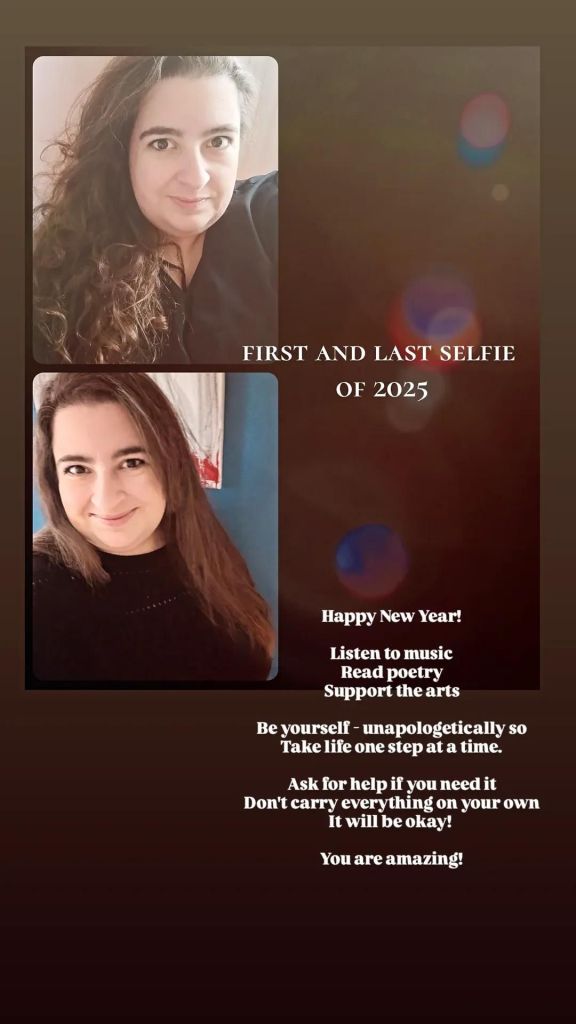
The first and last

Funny how people don’t change and yet change a lot. And I don’t mean the hair. Naturally curly but when I want to dress up I straighten it. It’s inside.

I still can’t hear the outside world on my left ear. It makes the inside louder, doesn’t it? Anyway… I like my last selfie of the year.

By the way, this was the first post of 2025:

Have a good 2026. Be less hard on yourselves. You are doing better than you think.

Lots of love from me to you

On the Outside

It’s December 29th. The sun is out but it is freezing cold. I am inside. Trapped. Not trapped inside but trapped in my head. Not mentally. But physically. On the morning of Christmas day, I lost my voice. It’s not back yet. Being silent or near silent for 4 days, that’s not like me. A couple of days ago, my ears got infected too. And although I was in a lot of pain during one particular night, there is no pain now. Just stuffed. I hear, but not well. It’s as if my head is filled with cotton. At least this morning my sense of smell is back.

I haven’t listened to any music. It makes me nervous not hearing it right and also if there are other sounds or noises, I cannot distinguish them and it all turns into an uncomfortable blur.

Four weeks ago I had the flu. Apparently,this is a flare-up after the adrenaline of work fell away. Two weeks of Christmas holidays and I have been sick for most of it.

It weighs heavy on me to be put on hold by my own body. And of course it is also a constant source of joy and jokes for my loved ones. They don’t mean any harm. But I think, for once I need to be held instead of being the one who holds.

I feel trapped without my voice. And I feel trapped not really hearing what is going on around me. I know it will get better. Of course it will, but right now, I am in the audience of my own life. Quietly trying to understand what the ones around me are whispering.